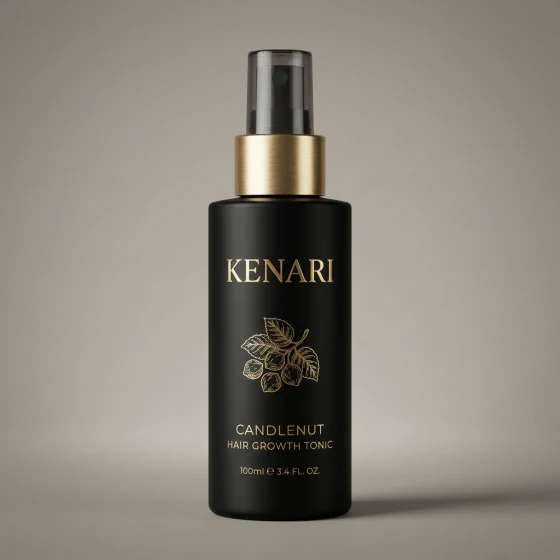

Hair & scalp care, Jakarta
Built on cold‑pressed candlenut
Indonesian families have rubbed minyak kemiri into their hair for generations. We press the nut cold in small batches and pair the oil with actives chosen for the scalp.
Shop by concern
[email protected]
Studio open Tuesday to Saturday, 10:00 to 19:00


Shop by concern
Pick what bothers you most. Each routine lists three products in the order you use them, and how often.
Product catalogue
The four products our customers buy again most often.
Ranges
Every Kenari product sits in one of four ranges, from leave-on scalp treatments to styling.

8 products
Tonics, serums and oils that go straight onto the scalp.
View range
5 products
Shampoo, conditioner, a weekly mask and a charcoal bar.
View range
5 products
Clay, paste, pomade, powder and salt spray, from matte to high shine.
View range
2 products
Growth oil and a folding comb for beard and moustache.
View range
Key ingredient
Candlenut (Aleurites moluccanus) grows across eastern Indonesia. Its kernels hold so much oil that they were once strung together and burned as candles, which is how the nut got its English name.
In Indonesian kitchens it is kemiri, and its oil, minyak kemiri, has been a home remedy for dry scalps and dull hair for generations. We use it as the base of most of our formulas, and add actives where the oil alone isn't enough.
What to expect
Scalp hair grows roughly a centimetre a month, and a hair that has stopped growing rests for two to three months before it falls. That is why we ask for ninety days before you judge a routine.
Day 0 to 30
Less oil by midday and less itching. Hairs that were already resting still fall, so the drain may look the same for now.
Day 30 to 60
Fewer hairs on the pillow and in the comb. Short, fine hairs can start to show along the hairline and at the crown.
Day 60 to 90
Hair that started growing in the first weeks is now two to three centimetres long and begins to fill in the parting.
Crown and hairline, in the same spot and the same light you'll use later. Start the routine that evening.
Retake the photo and compare. If you see no change, book a scalp reading and we'll look at what else is going on.
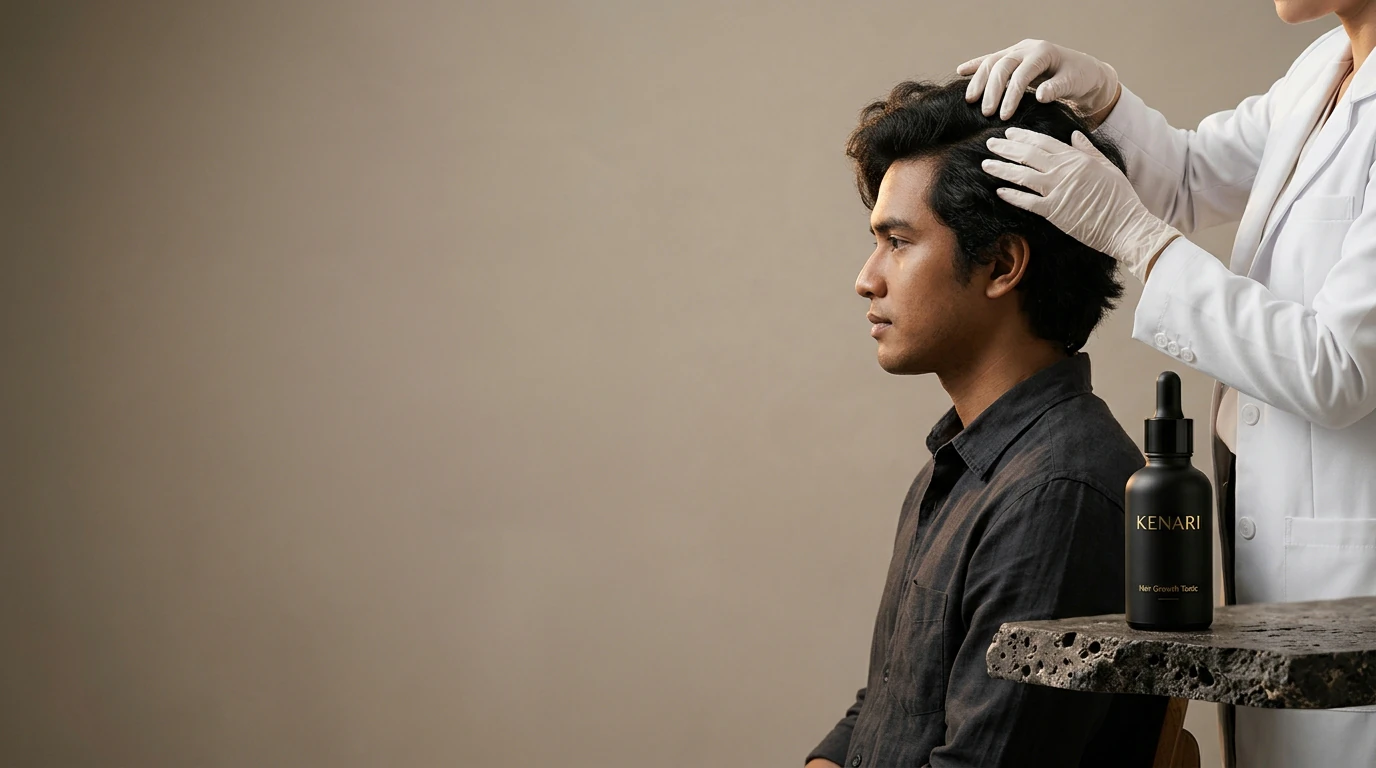
Scalp Clinic, Jakarta
A 30-minute reading with a trichoscope camera shows what a mirror can't: how dense the hair is, how thick each strand is, and where oil and flakes collect. You leave with a written routine.
Contact
Write to us about a product, your scalp or where to buy. An advisor replies within one working day. Barbershops and distributors use the same form.